Ogun Launches New Planning Regulations, Pioneers First State Building Code in Nigeria
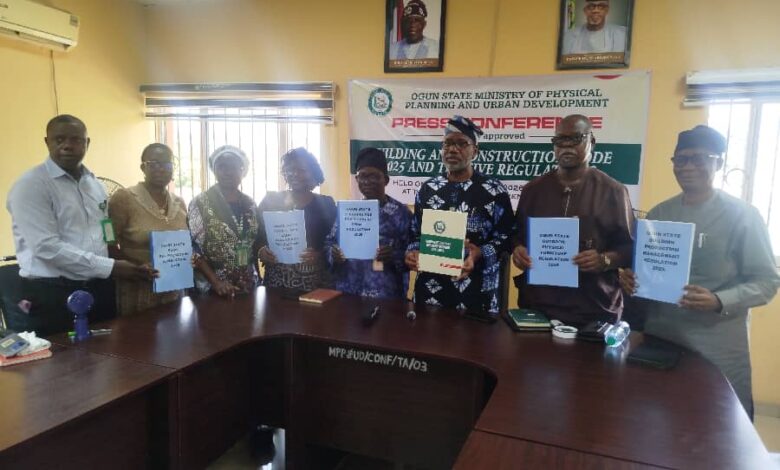
Abeokuta – The Ogun State Government has unveiled a comprehensive set of new physical planning regulations and introduced the Ogun State Building and Construction Code 2025, the first of its kind to be adopted by any state in Nigeria.
The announcement was made on Monday by the Commissioner for Physical Planning and Urban Development, Tpl. Olatunji Odunlami, during a press conference at the Ministry’s Conference Room in Oke Mosan, Abeokuta.
The newly approved instruments, which have received the endorsement of the Ogun State House of Assembly, include the 2025 editions of the State’s five key development regulations: the Planning and Development Permit Regulation, the Slum Regeneration Regulation, the Building Production Management Regulation, the Outdoor Physical Furniture Regulation, and the Layout and Land Subdivision Regulation. Alongside these is the pioneer Ogun State Building and Construction Code 2025, which is derived from the Nigerian National Building Code.




“These instruments collectively represent a bold and necessary step towards ensuring that Ogun State remains orderly, safe, environmentally sustainable, and nationally acknowledged in its physical planning and urban development activities,” Odunlami stated.
The Commissioner explained that the updated legal framework is a response to the rapid urbanization and economic growth witnessed in the state, which he described as the fastest-growing subnational economy and the industrial capital of Nigeria. He noted that the administration of Governor Dapo Abiodun restructured the Ministry in 2022 from a single agency into one ministry and three specialized agencies, necessitating continuous updates to regulations to keep pace with development.
To improve efficiency, the government has expanded its e-planning platform to six pilot zones, including Isheri, Ota, Abeokuta Metro, Abeokuta Central, Sagamu, and Ijebu-Ode, allowing planning permit applications to be submitted online from anywhere in the world.
While calling for the cooperation of all stakeholders in the built environment, Odunlami issued a stern warning against non-compliance and the misuse of road setbacks. He stressed that the government will no longer tolerate encroachment by shanties, makeshift structures, unauthorized signage, vehicle dealerships, and truck parks along major highways.
He listed affected routes, including the Lagos–Ibadan Expressway, the Muhammadu Buhari Expressway (Abeokuta–Sagamu Interchange), the Sagamu–Benin Expressway, the Lagos–Abeokuta Highway, and other major urban roads. Property owners facing these highways were directed to immediately clear unauthorized developments from setback spaces and replace them with landscaping or greenery.
“Anyone who carries out any development in violation of these regulations will face appropriate sanctions, including penalties, demolition of illegal structures, and criminal prosecution,” the Commissioner warned. He, however, commended individuals and corporate entities who have already complied, noting that the government is compiling a list of compliant organisations for public recognition.
The Commissioner presented the documents as the new reference materials for all physical development in the state, urging practitioners and the public to familiarise themselves with their contents.